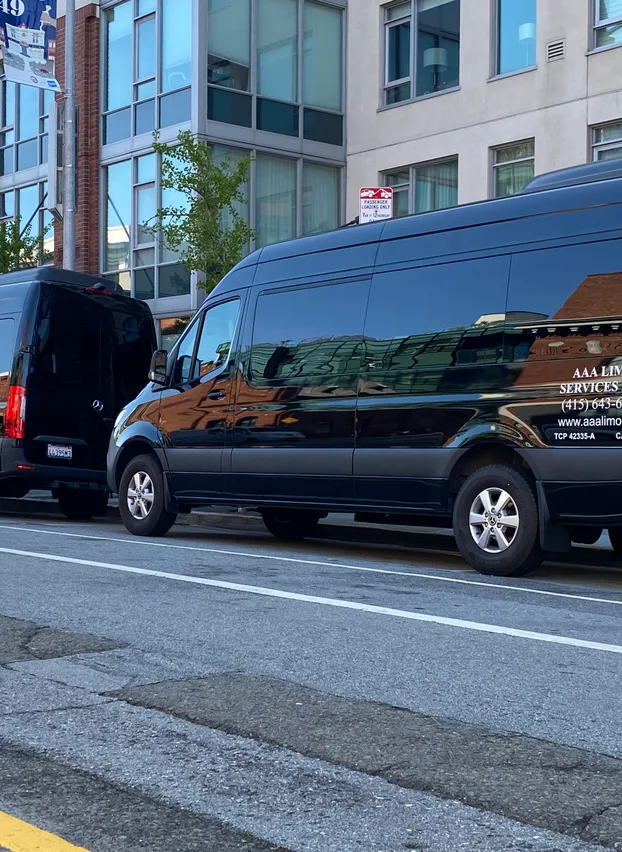
The short answer: plan around your hotel clusters and your session schedule, not your attendee count. Two conferences with 400 delegates each can need completely different transportation — one where everyone is in two hotels on the same block, another where they are spread across nine properties from Union Square to the airport corridor. And the hour that decides whether your transport plan worked is almost always the one right after the closing session.
Start with the hotel map, not the attendee count
When an event organiser calls us about a San Francisco convention, the first thing we ask for is not the number of delegates. It is the room-block list.
Attendee count tells us total capacity. The hotel map tells us how many routes we need, how long each loop takes, and how many vehicles have to run simultaneously to keep the interval short enough that nobody waits twenty minutes in the rain on Howard Street.
A tightly clustered block — three hotels within a few minutes of each other — can often be served by a single loop with a couple of vehicles running continuously. The same headcount spread across the city, or pushed out to airport-corridor hotels because the downtown blocks sold out, can need several independent routes. That is a materially different plan and a materially different quote, from an identical delegate number.
So send the room-block list early, even a draft one. It changes the shape of everything else.
A convention is really three separate transport jobs
It helps to stop thinking of it as "conference transportation" and start thinking of it as three jobs that happen to share a client:
- Arrivals and departures. Individually timed airport transfers spread across two or three days, largely driven by flight schedules rather than your agenda. See SFO airport transportation for how arrival meets are handled.
- Daily venue loops. Repeating hotel-to-venue service on a fixed interval, heaviest in the first ninety minutes of the morning and again at close.
- Evening events. A one-off, high-intensity move of a large share of your delegates to a single location, then back — usually the most compressed transport of the whole event.
Each has a different vehicle profile and a different failure mode. Treating them as one line item on a budget is the most common planning mistake we see.
The closing session is your hardest hour
Morning arrivals feel busy, but they self-stagger — people wake at different times, eat breakfast at different speeds, and trickle out.
The end of the day does the opposite. A closing keynote releases several hundred people onto the pavement within about ten minutes, most of them heading for the same handful of hotels, many of them dragging luggage because they are going straight to the airport. That is the moment a plan built on average demand falls apart.
Two things help more than adding vehicles:
- Stagger the release. If the agenda allows a closing reception, a sponsor giveaway or even coffee immediately after the final session, you flatten the peak substantially. Fifteen minutes of spread is worth more than an extra coach.
- Separate the airport-bound. Delegates leaving directly for SFO, OAK or SJC have luggage and a hard deadline. Splitting them onto their own vehicles keeps the hotel loop moving and stops bags from slowing every boarding.
Tell us when your closing session ends and roughly how many people fly out the same day. Those two numbers shape the back half of the plan more than the total headcount does.
Match the vehicle mix to the job
Different jobs within the same event usually call for different vehicles. Seating varies by configuration, so treat these as the upper end of each class.
| Job | Usual fit | Why |
|---|---|---|
| Speaker, sponsor and VIP transfers | Executive or First Class Sedan · Executive SUV | Individually timed, often confidential, and needs to wait rather than run a loop. |
| Airport arrivals and departures | Executive SUV · Mercedes-Benz Sprinter (up to 14) | Luggage-driven. Size for bags before headcount. |
| Hotel-to-venue loops | Minibus (approx. 22–27) · Shuttle bus (up to 37) | Fast boarding and a short interval matter more than capacity per vehicle. |
| Evening event moves | Shuttle bus · Motor coach (up to 56) | One compressed wave; fewer, larger vehicles reduce total trips. |
| Overflow and contingency | Sprinter on standby | Absorbs a late session, a weather change or a miscounted block. |
Passenger and luggage capacity varies by vehicle configuration. Confirm the number of passengers and amount of luggage when requesting a quote so the appropriate vehicle can be assigned. If you are weighing one class against another, our guide to choosing the right vehicle for Bay Area group transportation goes through the trade-offs in detail.
Find out where vehicles can actually stage
Large venues almost always separate passenger loading from the main entrance, and the loading area is frequently not where your delegates expect to be picked up. Hotels have their own constraints — some porte-cocheres cannot take a full-size coach at all, and a few downtown properties can only accept larger vehicles on a specific side street.
Three things worth confirming with the venue and each hotel well before the event:
- Where buses and coaches are permitted to stage, and for how long.
- Whether that area is signed for passenger loading, and how far it is from the door your delegates will use.
- Whether an event permit, dock booking or advance notice is required for repeated vehicle access.
Send us what you learn and we will build the routes around it. Discovering a staging restriction on the morning of day one is expensive in a way that no amount of extra capacity fixes.
Plan for the things that move
Conference agendas change. Sessions overrun, a sponsor adds a dinner, an exhibitor needs an early load-out. The plans that survive contact with a live event are the ones with a defined point of contact on both sides and a little slack built in — a standby vehicle, and an agreed way to reach a dispatcher who can move it.
For multi-day events we generally set up a single account contact rather than routing changes through whoever happens to answer. It matters most on day two, when something has already shifted.
What to have ready when you book
- Hotel room-block list, even in draft — the single most useful document you can send.
- Session schedule, particularly the start of day one and the end of the final day.
- Approximate share of delegates flying out on the closing day.
- Venue and hotel loading or staging constraints, if you have them.
- Any evening event locations and their expected attendance.
- Accessibility requirements, so vehicles and boarding time are planned properly.
We handle conference and convention work alongside ongoing corporate transportation and one-off charter bus rental, so a single event can draw on sedans, Sprinters and coaches without you coordinating multiple suppliers.