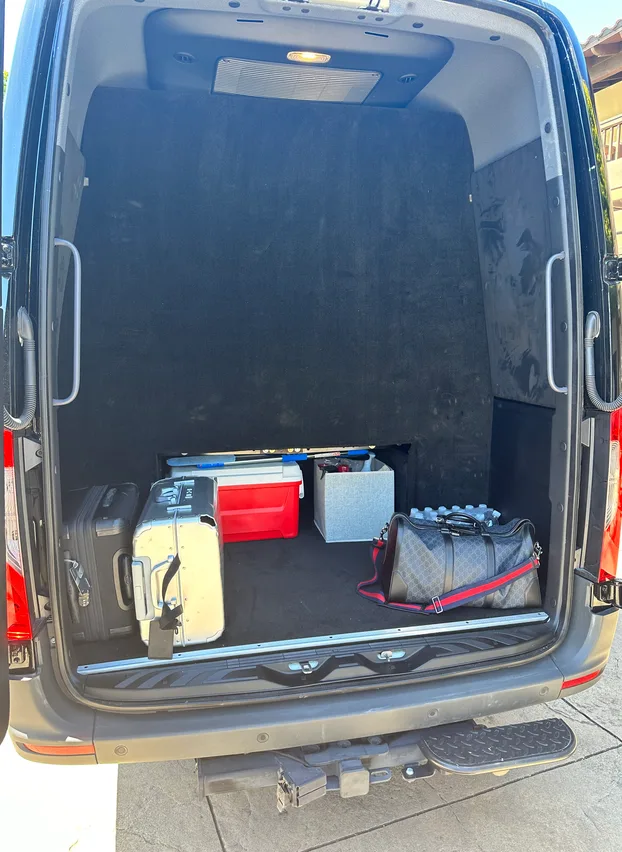
The short answer: count your passengers, then count your bags, then look at where the vehicle actually has to pull in. Most of the time it is the luggage and the pickup point — not the headcount — that decides which vehicle you need. A group of seven with carry-ons and a group of seven flying home after a week in Napa are two different jobs.
Start with the luggage, not the headcount
Almost every group transportation request we receive in the San Francisco Bay Area starts the same way: “There are twelve of us.” That is useful, but it is only half the question. A vehicle’s seat count tells you how many people can comfortably ride. It does not tell you how many people can ride together with everything they brought.
The gap between those two numbers is where most day-of problems come from. A vehicle that seats seven may seat seven people going to dinner in the city, or it may seat four people plus checked bags on the way to an international departure. Both are correct; they are just different trips.
Before you compare vehicle classes, write down three things: how many people, how many pieces of luggage and roughly what size, and whether anyone is bringing something oversized — golf clubs, ski bags, camera cases, trade-show materials, a stroller, or a wheelchair or other mobility equipment.
Passenger and luggage capacity varies by vehicle configuration. Confirm the number of passengers and amount of luggage when requesting a quote so the appropriate vehicle can be assigned. If you give us the bag count up front, that one detail usually settles the vehicle question in a single step.
Know the practical capacity of each vehicle class
These are the categories we book from across the Bay Area, Napa, Sonoma, Oakland, San Jose and the Peninsula. Seating varies by configuration, so treat the passenger figures as the upper end of each class, and our vehicle gallery shows what each of them looks like.
| Vehicle class | Passengers | Typically the right fit for |
|---|---|---|
| Mercedes-Benz E-Class Executive Sedan | Up to 2 | Solo executives, couples, point-to-point city runs and short airport transfers with light luggage. |
| Mercedes-Benz S-Class First Class Sedan | Up to 2 | Client-facing pickups and executive travel where the arrival matters as much as the ride. |
| Executive SUV | Up to 7 depending on configuration | Small groups, families, and airport transfers where bags outnumber people. |
| First Class SUV | Up to 6 | Executive groups that want sedan-level presentation with more room than a sedan. |
| Stretch Limo | Up to 8 | Weddings, proms, celebrations and special occasions. Luggage space is limited; confirm your passenger and luggage requirements when requesting a quote. |
| Mercedes-Benz Sprinter | Up to 14 | Team offsites, wine-tour parties, wedding-party moves and mid-size airport groups. |
| Minibus | Approximately 22–27 | Conference shuttles, employee routes and group day trips. |
| Shuttle bus | Up to 37 | Continuous-loop shuttles, hotel-to-venue runs and larger employee programs. |
| Motor coach | Up to 56 | Full-group moves, longer-distance charters and multi-day event transportation. |
Vehicle model, color, interior configuration and luggage space vary within each class, and amenities differ between our own vehicles and affiliate-supplied vehicles on nationwide and international work. If a specific feature matters to your trip, ask us to confirm it for the exact vehicle assigned rather than assuming it comes with the class.
One larger vehicle, or two smaller ones?
This is the decision groups get wrong most often, and it is worth making deliberately.
Splitting into two vehicles gets everyone seated with room to spare and can be easier to route into tight pickup points. The trade-off is that two vehicles arrive as two separate events. On a wine tour with several stops, that means two groups getting out, two groups getting back in, and someone trying to keep both on schedule. For airport departures it can also mean two different curb assignments.
Moving up one vehicle class keeps the group together, keeps the day on one clock, and usually loads faster than two vehicles do. The trade-off is access: a Sprinter reaches places a minibus cannot, and a minibus reaches places a motor coach cannot.
Our general guidance: if the group has to stay together on a timed schedule — a wedding party, a board dinner, a conference block — size up. If everyone is simply travelling to the same destination with no timing dependency between them, splitting is often the cleaner answer.
Check where the vehicle actually has to pull in
A vehicle you can seat is not always a vehicle you can park. Before confirming a larger class, check the pickup and drop-off points for:
- Residential streets and driveways. Narrow streets, steep grades and low-hanging trees are common in Bay Area neighborhoods and can rule out a coach even when the group size would support one.
- Hotel entrances. Some porte-cocheres have height limits that a sedan or SUV clears easily and a taller vehicle does not.
- Winery and estate driveways. Napa and Sonoma properties vary widely. Some ask larger vehicles to stage in a specific area, and some restrict them entirely, so confirm with the property before you lock in the vehicle.
- Event venues and convention centers. Large venues usually have designated bus staging that is not the same as the passenger entrance. Knowing this in advance changes how far your group walks.
- Airport arrivals. Commercial vehicle access at SFO, OAK and SJC is handled differently from private-car pickup, and larger vehicles are directed to different areas than sedans.
Every one of these is far easier to solve a week ahead than on the day. If you are not sure about a location, send it to us and we will tell you what fits.
Match the vehicle to the shape of the trip
Trip type matters as much as group size:
- Point-to-point airport transfers are luggage-driven, so size for bags first. Our SFO airport transportation page covers how arrivals and meet points are handled.
- Multi-stop wine tours are access-driven and involve repeated loading and unloading, which favors a vehicle everyone can board quickly. See Napa Valley private wine tours for how these days are usually structured.
- Corporate roadshows and executive travel are schedule-driven and often need the same vehicle standing by between stops rather than the largest one available. See SF Bay Area corporate transportation.
- Recurring employee routes are throughput-driven. The right answer depends on riders per run and time spent at each stop, not on the peak headcount. Our employee shuttle service page explains how routes are planned.
- Large one-time group moves are usually best served by charter bus rental, where the whole group travels on one schedule.
What to have ready when you book
Groups that give us these five details up front almost never end up with the wrong vehicle:
- Final passenger count, and whether it might still grow.
- Bag count, plus any oversized or special items.
- Exact pickup and drop-off addresses, including which entrance.
- Whether the group must arrive together or can arrive in waves.
- Any accessibility needs, so the vehicle and the boarding time can both be planned properly.
If you are torn between two classes, tell us both and we will tell you which one we would send — and why. That conversation takes two minutes and is the most reliable way to avoid a vehicle that technically seats your group but does not actually fit your trip.